Why Putin’s Next Move in his War Against Ukraine is Against Europe
With Ukraine’s momentum shifting, Putin may be calculating that a lightning strike on NATO’s eastern flank is his only way out.
September 6, 2026
Serious analysts of Russian President Vladimir Putin’s strategy have recently had to consider the surprise visit to Moscow by CIA chief John Ratcliffe. This visit in late August now has many convinced that Russia is planning to attack the Baltic countries soon.
Here is why that is a very likely scenario.
Why the mystery about whom Ratcliffe met in Moscow?
It appears likely that Ratcliffe met Putin himself, even though Russian media shied away from acknowledging that. As in old Soviet “Kremlinology” times, an official air of mystery prevails.
But the puzzle can be solved. Just consider that, if Ratcliffe had only met his opposite number — the boss of Russia’s Foreign Intelligence Service (SVR), Sergei Naryshkin — as some Russian media claim, he would probably have gone to SVR headquarters, which is quite far to the southwest of Moscow.
Similarly, if, as other Russian media outlets indicate, Ratcliffe had come to meet Alexander Bortnikov, the boss of the Federal Security Service (FSB), the successor organization to the KGB, he would probably have gone to the infamous Lubyanka, headquarters of all Soviet and then Russian political police forces since 1917.
Yet Ratcliffe went to the Kremlin, and Putin cancelled an important appointment that day.
Covering up for a war going badly for Putin and Russia
The mere fact that the Russian propaganda machine is unable to be consistent on the simple question of whom Ratcliffe met suggests something important is being hidden.
The war in Ukraine is going badly for Putin, including on the strictly military front. The Russian invasion force suffered 80,000 casualties in July and August alone.
The recruitment of volunteers having run its course, the size of that force has gone from about 750,000 men on the ground in Ukraine at the beginning of 2026 to less than 700,000 today.
It was completely expelled from the Dnipropetrovsk oblast in August and is on the back foot in several places, including the Donbas city of Lyman, which was considered lost for Ukraine not that long ago.
The military momentum has shifted
The final figure is pending, but the Ukrainians may have retaken 1,000 km2 of territory occupied by Russia in August. That is not a colossal stretch of land in absolute terms, but it is more than the cumulative net Russian gains since the beginning of the year.
As in all wars, figures can be fairly challenged, but it is clear to honest observers, including most Russian military bloggers, that the war momentum has shifted to the Ukrainian side.
Putin’s parallel world
Even if Putin lives in a parallel world — lately he likes to repeat that he has the fourth-largest economy in the world in terms of purchasing power parity — he must be aware that his refineries and logistics centers are going up in smoke.
He also must be acutely aware of his declining popularity. And he obviously must know, despite the increasingly grotesque lies of his generals, that he still has not even achieved his minimal objective for the summer.
That plan was to conquer the “Donbas fortress” around the cities of Kramatorsk and Sloviansk. This objective has now conveniently become the objective for the entire year, and it may before long become the objective of next year’s spring offensive.
Defeat remains inconceivable for Putin and all regime insiders
What has not changed is that defeat remains inconceivable for Russia. Indeed, Putin’s regime resembles Monty Python’s Flying Circus in this respect, only a lot less funny.
Even so, the Russian president needs to push the pace, and he knows it. Just look at the quote recently reported by The Economist: “They will hang me.”
No nukes, say the SCO partners
Russia did not use tactical nukes when Ukraine seized part of the Kursk oblast two years ago, even though Moscow’s official doctrine compels its leaders to use them. Instead, Putin asked his buddy in North Korea, Kim Jong Un, for help.
Whatever Russian propaganda wants us to believe, the nuclear option is no longer credible. The massive use of chemical and biological weapons is not credible either.
The reason why use of any of Putin’s Armageddon options, much touted by Dmitry Medvedev, is even less likely now is this: Putin was publicly told by China’s Xi Jinping, India’s Narendra Modi and Kazakhstan’s Kassym-Jomart Tokaiev a few days ago at the Shanghai Cooperation Organization Summit in Bishkek that he needs to stop his war.
Putin’s three remaining options. Only one would be effective
In practice, acceleration of the conflict from Russia can only take one of three forms: first, more lethal attacks on Ukrainian civilians (and that, alas, is already happening).
Second, more aggressive hybrid warfare against Western Europe (and that, as Germans see on their soil almost every day now, is happening too).
And third, mobilization.
The third option is the only one that could make a real difference on the battlefield.
Ukrainians see that unhappy development coming. President Volodymyr Zelensky is talking about a mobilization of 600,000 men by the enemy. Western analysts are putting forward somewhat lower figures, between 200,000 and 500,000.
A replay of 1917 or 1991?
But everyone agrees that to try to make a real difference, it is necessary to draft on a scale that might provoke a violent reaction from Russian society. And nothing frightens Putin more than the prospect of a repeat of 1917, the end of Tsarist Russia, or of 1991, which brought about the end of the USSR.
Mobilization would also have to occur quickly. One hundred and thirty thousand men between the ages of 20 and 50 crossed the border to Georgia in August. Neither the Russian economy nor Russian propaganda can afford another brain and arms drain.
That is one more reason why, in all his desperation, Putin’s ideal date for such a move must be just after the parliamentary elections in Russia that will take place September 18-20.
Mobilization by stealth?
Mobilization must also be properly justified, or at least cast as legitimate, ideally as indispensable to save the fatherland.
What complicates this move is that the regime denies any intention of mobilization and once again now openly mocks the “warmongering Cassandras of NATO.”
This is no longer February 2022
That was its same message until February 23, 2022 in response to international warnings about the full-scale invasion itself. But we are no longer in 2022.
Russians in general, and Muscovites in particular, now spend their nights in queues in front of almost-empty gas stations or listening to the ugly song of Ukrainian drones.
The war no longer amuses them at all. Any mobilization-related about-face in 2026 would be much harder to manage than four and a half years ago.
Putin’s mobilization move hinges on a NATO attack
Given all that, there is only one path available to Putin that would allow Putin to justify mobilization: NATO must attack Russia. And here we finally come to the Baltics.
In an “ideal” world, hybrid warfare would achieve just that. But what was long the historical strength of Russia’s hybrid warfare — deniability — now looks like a handicap.
Putin’s hybrid warfare against NATO countries doesn’t move the needle
Unfortunately for Putin, even heavy drones exploding in Poland and Romania, bombing of armament sites across Europe and huge attacks on German power plants don’t move the needle. Europeans refuse to go to war. Full stop, Punkt.
U.S. President Donald Trump, who just invited Russia to the G20 Summit in Asheville, loathes NATO day in day out, but he is busy trying to save his own skin on another front. He will be the last to suggest a firm Western response.
The Kremlin wants NATO’s tolerance to disappear
From the Kremlin’s perspective, NATO’s tolerance threshold is hopelessly high. But that threshold exists, and this is probably something Ratcliffe confirmed on August 25.
Putin is cornered, and according to his perverse logic must take a huge risk. He must provoke NATO in an unprecedented way. He must invade NATO territory. He would not invade a full country of course, since he does not have the bandwidth for that. He would attack just a tiny corner of one.
Inventing the Baltic “fascists”
The plan is simple — repeating the Ukraine “justification” playbook. Using that frame, the Russian army would invade a neighboring country “to save the local Russian speakers” from atrocities by the Baltic “fascists.”
Putin would sign the annexation decree the next day, and then calmly await NATO’s reaction while preparing the mobilization decree.
Gaming out the Baltics chess game
Of course, there is a possibility that NATO does not launch a counteroffensive. Putin would then claim a landmark success of the invincible Russian army likely to make the war in Ukraine instantly more popular.
But it would not provide him with real grounds for any large level of troop mobilization.
The in-between scenario
Putin’s ideal scenario would therefore be something in between: a major NATO disagreement over which response to adopt, and a counteroffensive limited to the Baltic, Finnish and Polish armies.
There are only three “candidates” for an invasion. One is the Suwalki corridor, the 80 km of Polish-Lithuanian border that separate the Russian exclave of Kaliningrad from Belarus. Another one is the Latvian border region with Russia. The third one is the city of Narva in Estonia.
Three sub-optimal options
The first two options have big drawbacks. As tempting as the Suwalki corridor looks, it is heavily armed with forces from many countries.
Kaliningrad faces significant logistical issues. After all, Belarus is not reliable, and the contours of the would-be annexed territory are unclear.
As for Latvia, its eastern border consists of forest and scarcely populated rural areas. Claiming that Russia had to intervene to save Russian-speaking wild boars would not come easy, and the contours of the would-be annexed territory would be unclear, too.
Why Narva?
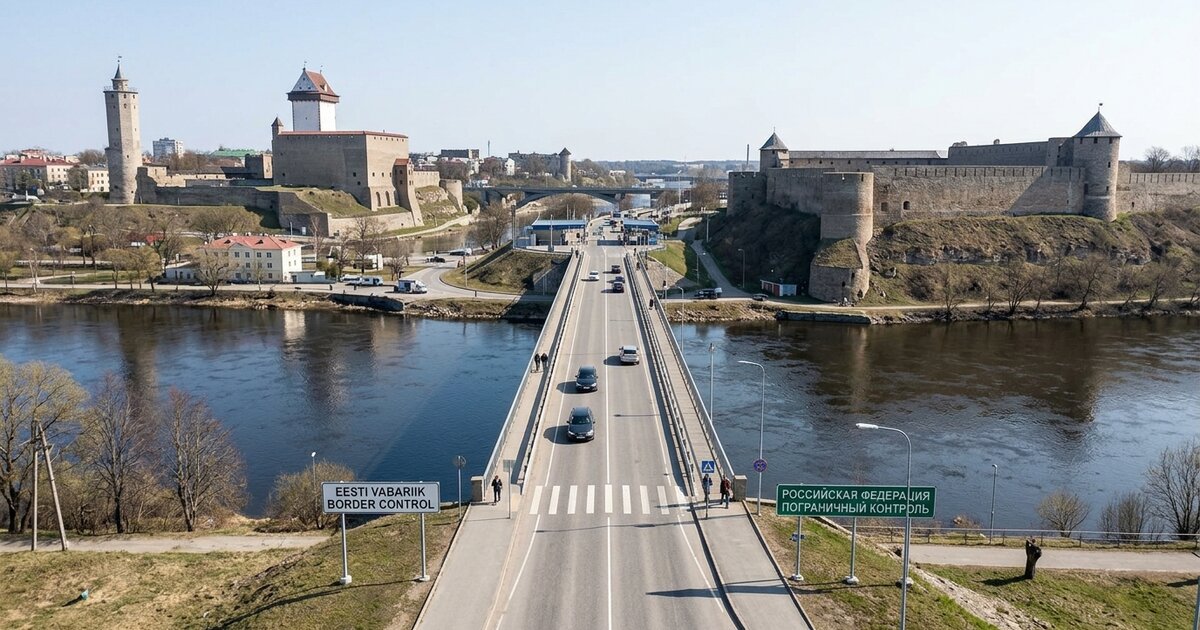
In contrast, Narva is a tempting target. It is a city, with clear municipal boundaries. It is not large (50,000 inhabitants) but is still Estonia’s third-largest. It is beautiful and full of history.
Narva has a predominantly Russian-speaking population and has been the theater of numerous Russia-inspired provocations over the years. Finally, it is located directly on the Russian border, separated only by a river (also called Narva).
Practical obstacles remain
From a Russian military perspective, there is one big catch. There is only one bridge into the city, and the Estonians would surely blow it up before the first Russian armored vehicle crosses it.
But it now appears that Russia is preparing its bank of the river for a would-be alternative. If this preparation were openly advertised, it might be a diversion. But it is rather discreet, so it is wiser to see it as a real preparation.
What was Ratcliffe’s message to Putin?
If Ratcliffe told Putin not to attack Narva, the former will not have made the latter change his mind.
Putin has always taken warnings about his dark designs as confirmations that he is in the right. Remember also that, even more so than with other negative personality traits, the assumption of certainty about being right gets worse with age — especially when the subject is contradicted.
Triggers aren’t that hard to identify
As always in wars, the triggering events are less difficult to anticipate than the duration of conflicts and their consequences.
What is clear at this stage is that it seems entirely pointless for now to wade into political-fiction scenarios around a third world war.
The downside of attacking NATO territory
Putin is not going to win the war in Ukraine by attacking NATO. Even if the move against Narva takes place without any major incident, mobilization is a disastrous idea.
It would simply send hundreds of thousands of unmotivated Russian men to certain death.
Those who were motivated to fight in the war have progressively disappeared over the last four years of combat. Mobilizing yet more poorly trained and poorly equipped troops would only mean that Putin is digging a deeper hole for himself.
For the record, Ukraine will have produced around 7 million drones this year, including at least 6 million FPV drones intended to kill one Russian invader each.
How does Europe respond?
Which brings us to the final issue to be considered: How does Europe respond to any Putin invasion and annexation of an EU city?
First, Europeans would immediately decide to help the Ukrainians even more, and the Americans may well start helping them very seriously again.
One does not need to have graduated top of class from Harvard to sense that Trump would fly into a dark rage if Putin humiliates him a few weeks before U.S. midterm elections that already appear set to go very badly for Trump’s party.
This applies all the more as Trump recently went on record to say that Russia would not attack NATO while he is president.
Second, there would be significant political consequences in Western Europe in general and France in particular.
Whether they are corrupt or useful idiots, Putin’s far-right and far-left supporters would have to explain themselves. And that would be an excellent thing.
Third, the Narva scenario might be wrong.
Just recall that the great humorist Pierre Dac used to say that prediction is a difficult art, especially when dealing with the future.
In fact, it would be better if Putin stayed his hand, and Xi’s growing frustration with him does offer a tiny ray of hope that he will.
Yet as any Frenchman like myself should know, based on the catastrophic experience we had as a people in 1939-1940 with the Phoney War, there is something far worse than wrongly predicting an invasion: failing to see it coming.
Takeaways
The fact that the Russian propaganda machine is unable to be consistent on the simple question of whom CIA chief John Ratcliffe met when he went to Moscow in late August suggests something important is being hidden.
Putin must be acutely aware of his declining popularity. The Russian president needs to push the pace of his war in Ukraine and hybrid warfare against the West, and he knows it.
Putin is cornered, and according to his perverse logic must take a huge risk. He must provoke NATO in an unprecedented way.
Russia did not use tactical nukes when Ukraine seized part of the Kursk oblast two years ago, even though Moscow’s official doctrine compels its leaders to use them. Instead, Putin asked Kim Jong Un for help.
Nothing frightens Putin more than the prospect of a repeat of 1917, the end of Tsarist Russia, or of 1991, which brought about the end of the USSR. A large-scale mobilization could bring about that outcome.
The Russian regime openly mocks the “warmongering Cassandras of NATO” for considering a coming Russian move possible. That is the same stance the regime took in February 2022 in response to warnings about an invasion of Ukraine.
Russia could return to its Ukraine “justification” playbook. Using that frame, the Russian army would invade NATO territory “to save the local Russian speakers” from atrocities by the Baltic “fascists.”
Putin’s ideal scenario would be a major NATO disagreement over the response to a Russian incursion, and a counteroffensive limited to the Baltic, Finnish and Polish armies.
Narva is a tempting target. It is not a large city (50,000 inhabitants) but is still Estonia’s third-largest. It is beautiful and full of history and has a predominantly Russian-speaking population.
Putin is not going to win the war in Ukraine by attacking NATO. Even if a move against Narva takes place without any major incident, mobilization is a disastrous idea.
Whether they are corrupt or useful idiots, Putin's far-right and far-left supporters would have to explain themselves if Russia took military action against a NATO ally.
Putin’s ideal date for such a move must be just after the parliamentary elections in Russia that will take place September 18-20.